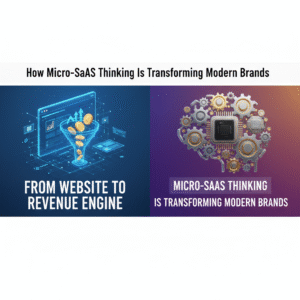
In 2025, the brands winning online are not the ones with the prettiest designs or the most pages. They’re the ones who treat their website like a product, not a brochure.
This shift is unlocking a new category of digital growth: websites that generate predictable revenue — not just impressions.
Instead of static pages, companies are now transforming their sites into Micro-SaaS driven ecosystems — where every interaction creates data, every user behavior triggers intelligent automation, and every digital touchpoint contributes to revenue.
What is Micro-SaaS Thinking?
Micro-SaaS is not just about building subscription software.
It is a mindset of productizing value:
- Focus on solving one high-value problem extremely well
- Build repeatable value loops inside the user journey
- Automate delivery, feedback, follow up and conversion
- Monetize through intelligent micro recurring value streams
Now apply this thinking to websites — and they stop being passive assets.
They become intelligent revenue engines.
Websites That Think — Not Just Inform
Traditional websites are informational.
Micro-SaaS websites are operational.
Old Website Model Micro-SaaS Website Model
Shows information Creates ongoing value loops
Generic CTA Personalized conversion flow
Requires manual marketing Self-optimizes based on data
Passive digital identity Active revenue generator
This is the difference between having a presence and having a profit system.
Examples of Micro-SaaS Elements Inside Websites
- ROI & Pricing calculators
- Smart lead qualification engines
- Auto nurture pipelines connected to CRM
- AI guided product finder flows
- Self-service onboarding & demo schedulers
- AI support layer to reduce tickets
- Dynamic personalization modules based on behavior
These components behave like small SaaS units — embedded inside the website.
Each of them increases lifetime value, conversion efficiency, trust, and customer retention.
Why This Matters Now
The digital market is too competitive for passive websites.
Attention is expensive. Acquisition costs are rising. Personalization expectations are high.
The brands that win now are the ones building systems — not pages.
Systems that learn. Systems that adapt. Systems that convert.
3 Micro-SaaS Web Models for Modern Businesses
- Conversion Automation Engines
From form submissions → to AI lead scoring → personalized follow up → scheduled call.
No manual chasing. No wasted pipeline. - Interactive Value Tools
ROI calculators, cost savings estimators, benchmark scoring tools.
These tools increase conversion dramatically because users generate their own proof. - Post-Purchase Intelligence Systems
Personalized upsells, premium micro subscriptions, loyalty vaults, targeted education layers — creating ecosystem stickiness without increasing acquisition cost.
The New Agency Skill: Product Thinking
Most agencies still build “pages”.
Next-generation agencies build digital products.
This requires:
Skill Why it matters
Product Strategy Value loops > deliverables
System Design Self-running automation
Data Intelligence Behavior-driven growth
The value shifts from design delivery → to outcome delivery.
The Saaskode Approach
At Saaskode — we engineer websites the same way SaaS companies engineer products:
- Modular
- Intelligent
- Extensible
- Outcome-centric
We don’t ask: “Which pages do you want?”
We ask: “What revenue loops can we embed into your digital presence?”
This is where the future agency model is heading.
Final Thought
In the next 24 months — static websites will disappear.
Websites will become intelligent Micro-SaaS systems — continuously learning, improving, and selling.
The future web is not built. It is engineered.
Build your next-gen web experience with Saaskode — where strategy, AI and engineering converge.